
©Standpunkt
Participants and Collaborators
Sinfonieorchester Opus125 e.V. — Orchestra and artistic development of the project
Javier Álvarez Fuentes — Musical direction and music mediation
Alicia Carrasco — Cante flamenco
Joaquim Santos Simões — Guitar
Yaroslava Ihnatenko — Guitar
Belmin Okanović — Guitar
Juan Manuel Molano — Guitar
Robert Schumann Hochschule Düsseldorf
CREATiVE SPACE — Media coverage and training in photography, video, podcasting and journalistic writing
Gesamtschule Hardt — Participating institution in the educational and media cooperation
Gymnasium Gartenstraße — Participating institution in the educational and media cooperation
Geschwister-Scholl-Realschule — Participating institution in the educational and media cooperation
Musikschule Mönchengladbach
Standpunkt — Editorial coverage of the project
CHAOS Schülerzeitung — Participation in the media cooperation
musik+ / MUSIKFREUNDE e.V. — Project support
Rotarier Club Mönchengladbach — Project support
Stadt Mönchengladbach — Project funding
Kulturbüro MG — Project funding
Así suena España
What can an audience discover when a programme does not present a culture as a postcard, but invites listeners to enter its sound, its stories and its contradictions?
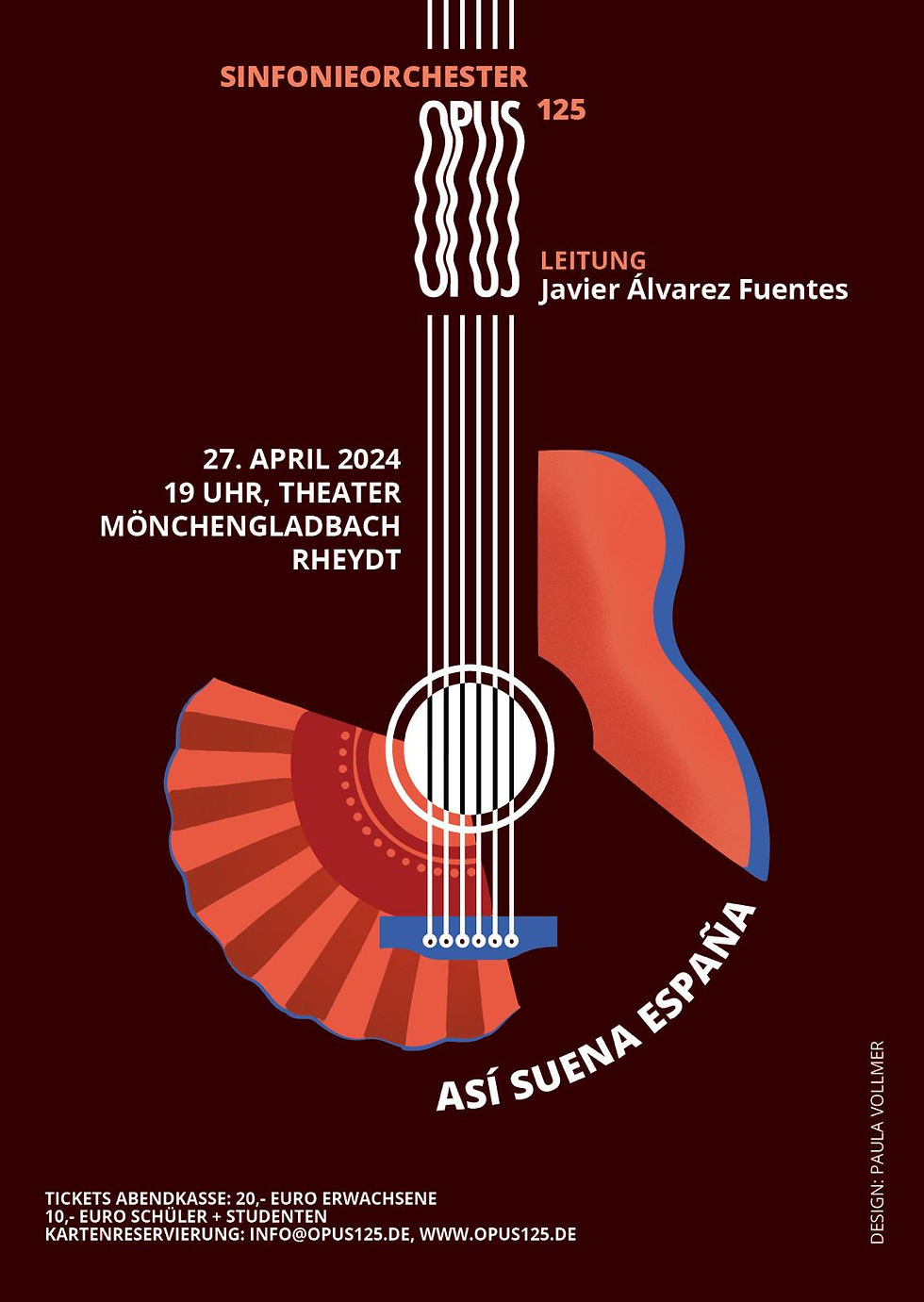
With Así suena España – So klingt Spanien, the Sinfonieorchester Opus125 e.V. developed a project dedicated to the diversity of the Spanish musical tradition. The programme brought together works by Enrique Granados, Joaquín Rodrigo and Manuel de Falla, moving from the lyrical intensity of Goyescas to the rhythmic and dramatic world of El amor brujo.
The concert took place on 27 April 2024 at the Theater Mönchengladbach under my musical direction. The evening opened with Granados’ Intermezzo, followed by Joaquín Rodrigo’s Concierto andaluz for four guitars and orchestra. The soloists Joaquim Santos Simões, Yaroslava Ihnatenko, Belmin Okanović and Juan Manuel Molano, associated with the guitar classes of Joaquín Clerch and Alexander Sergei Ramirez at the Robert Schumann Hochschule Düsseldorf, performed the solo parts. The dramatic centre of the programme was Manuel de Falla’s ballet suite El amor brujo, together with flamenco singer Alicia Carrasco.
But the project began before the concert itself. In cooperation with the Gesamtschule Hardt, the Gymnasium Gartenstraße and the Geschwister-Scholl-Realschule, young participants explored the programme and, in particular, El amor brujo. In a first meeting, we worked on the story, its context and the way de Falla transforms emotions such as pain, jealousy and liberation into musical narrative.
Building on this, the CREATiVE SPACE teams introduced the participants to photography, video, podcasting and journalistic writing. The young people developed their own media coverage of the project and also attended an open rehearsal of Opus125 at the Musikschule Mönchengladbach, observing directly how a work changes throughout the rehearsal process.
During the concert, the introduction to El amor brujo continued this same idea. The aim was not to explain the music before it was heard, but to offer a few keys that would allow the audience to recognise the story and build a more conscious relationship with what was happening in the orchestra. Alicia Carrasco’s interpretation gave voice to the emotional world of the work and strengthened its connection to the tradition of cante flamenco.
Así suena España grew out of the conviction that interpreting the music of another culture requires curiosity and careful listening. And that what an orchestra discovers during its work can also be shared with the audience — not to reduce music to an explanation, but to open new ways of listening.


Javier Álvarez Fuentes

Navigation
Social Media